Which Is the Better Choice for Your Skin?
Article 5 of 12
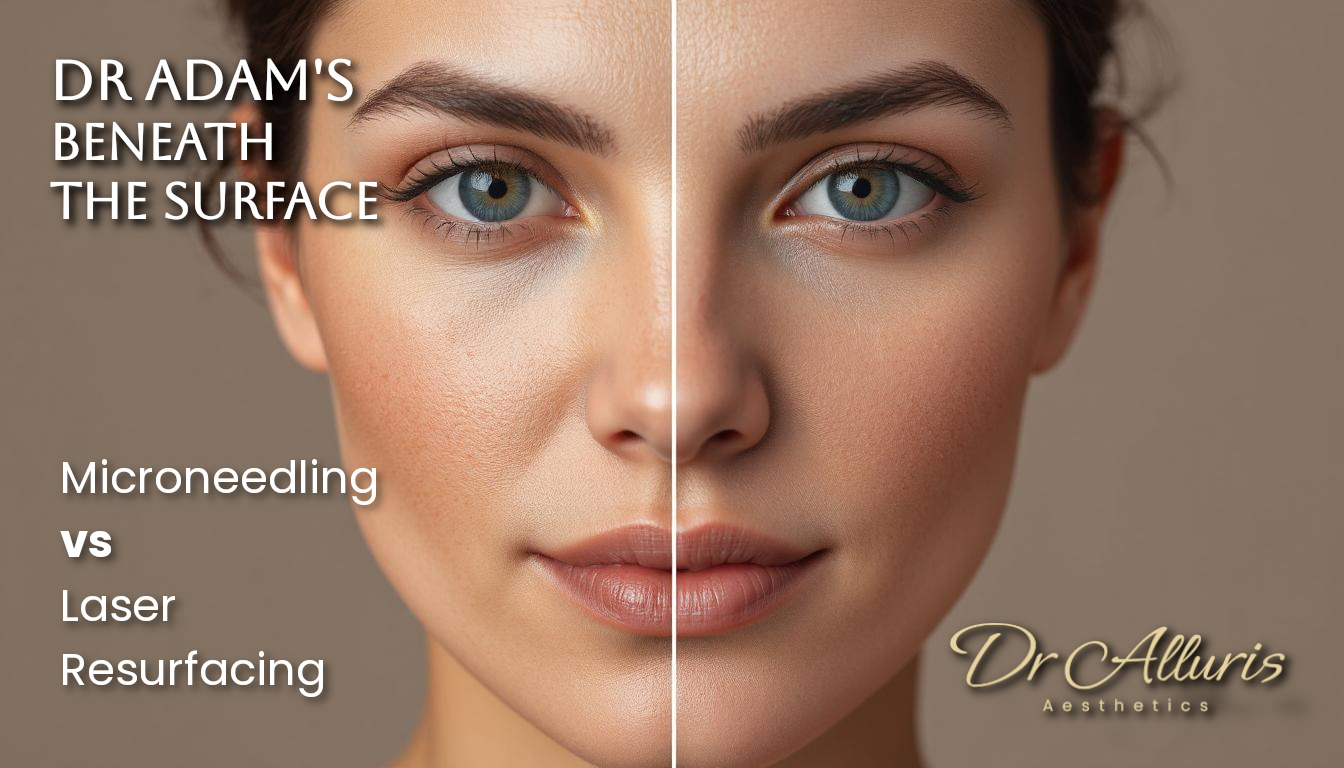
Microneedling and laser resurfacing are both well-established approaches to skin rejuvenation, and the question of which to choose comes up often. Both are scientifically supported. Both can produce meaningful improvements in texture, tone, and scarring. But they work through different mechanisms, carry different recovery profiles, and suit different skin types and lifestyles in ways that matter a great deal when you are deciding what is right for you.
I offer Dermapen microneedling at Dr Alluris Aesthetics. I do not offer laser resurfacing. This article is not a sales pitch for one over the other. It is an honest comparison of both so you can make an informed decision, and if laser resurfacing turns out to be the better fit for your situation, I will tell you that clearly at consultation.
How Each Treatment Works
Microneedling uses ultra-fine needles to create controlled micro-channels in the skin. This triggers the body's natural wound-healing response, stimulating collagen and elastin production and encouraging cell turnover. Modern motorised devices such as the Dermapen allow precise control over needle depth and treatment intensity, making it adaptable to a wide range of skin concerns and skin types. The treatment can also be combined with regenerative agents such as exosomes, which penetrate deeply through the micro-channels to amplify the biological effect significantly.
Laser resurfacing uses light energy to achieve a similar overall goal through a fundamentally different mechanism. There are two main categories:
- Ablative lasers such as CO₂ or Er:YAG remove the outer layer of skin entirely, triggering a more aggressive renewal process. The results can be dramatic but the recovery is significant
- Non-ablative lasers such as Fraxel heat the deeper layers of skin without breaking the surface, encouraging collagen production more gradually and with less downtime than ablative options
What Each Treats Most Effectively
Both treatments address overlapping concerns, but with different strengths depending on severity.
Microneedling is well suited for:
- Early fine lines and skin texture irregularities
- Enlarged pores and mild roughness
- Superficial acne scarring
- Mild pigmentation and tone unevenness
- Overall skin quality, hydration, and radiance, particularly when combined with exosome therapy
- Scalp treatment for hair thinning when used with regenerative agents
Laser resurfacing, particularly ablative forms, tends to be more appropriate for:
- More advanced wrinkles and significant sun damage
- Deep or pitted acne scarring where superficial remodelling is insufficient
- More pronounced pigmentation changes such as melasma or significant sunspots
- Skin laxity in selected cases where thermal tightening is needed
In broad terms, microneedling offers a more flexible and gentler path that suits a wider range of concerns and skin types. Ablative laser resurfacing offers more dramatic correction in fewer sessions but comes with a meaningfully higher recovery burden and a more restricted suitability profile.
Downtime and Recovery
Downtime is often the deciding factor in practice, and the difference between these treatments is significant.
With Dermapen microneedling, most people experience mild redness and sensitivity for one to three days. Minor flaking is possible. Most people return to their normal routine the following day, and makeup can typically be applied within 24 hours. It is genuinely a low-downtime treatment when performed at appropriate depths.
Non-ablative laser treatments produce more redness and swelling, often lasting several days, but still fall within what most people would consider a manageable recovery window.
Ablative laser resurfacing is a different category entirely. Expect visible redness, crusting, and peeling for at least one to two weeks. The skin is effectively wounded and must heal from the inside out. This is not a subtle recovery process, and it requires careful aftercare and sun avoidance during healing.
Skin Tone Safety
This is one of the most clinically important differences between the two approaches, and one I consider carefully at every assessment.
Microneedling is safe for all skin tones, including darker Fitzpatrick types IV to VI, because it does not involve heat or light energy. The risk of post-inflammatory hyperpigmentation is low when the treatment is performed correctly and at appropriate depths.
Laser resurfacing, particularly ablative forms, carries a meaningfully higher risk of pigmentation changes in darker skin tones, including unwanted lightening or darkening of the treated area. This does not make laser treatments impossible for darker skin, but it requires significantly more careful assessment, experienced hands, and in many cases a preference for non-ablative options over ablative ones. It is not a decision to take lightly or on the basis of a brief consultation.
Results Timeline
With microneedling, results develop gradually as new collagen forms over four to six weeks following each session, with continued improvement over the months that follow. A course of three to six sessions is standard for most concerns, particularly scarring and textural irregularities. The improvement unfolds progressively, which is both its strength and its limitation compared to more aggressive options.
Ablative laser resurfacing can produce more pronounced change from a single session, though the full result still takes weeks to develop as the skin remodels. Non-ablative lasers are more gradual and typically also require multiple sessions for meaningful results. In both cases, maintenance and sun protection are important for preserving results long term.
Why I Focus on Microneedling
My background is in surgery, and my approach to aesthetic medicine has always been shaped by a preference for techniques that engage the body's own healing capacity with as little collateral damage as possible. Microneedling, particularly when combined with regenerative agents such as exosome therapy, sits very comfortably within that philosophy.
It gives me precise control over depth and intensity, carries a favourable safety profile across all skin tones, produces meaningful and progressive results, and can be tailored to each person's specific concerns and anatomy. For the vast majority of the concerns I see in clinic, it is the more appropriate and more sustainable choice. Where a client's presentation suggests that laser resurfacing would genuinely serve them better, I will say so and direct them accordingly.
A Simple Next Step
If you are weighing up microneedling against laser resurfacing and want a clear, honest view of which makes more sense for your skin, a consultation is the most useful starting point. I will assess what you are trying to address, explain what is realistic with each approach, and give you a recommendation I can justify clinically.
WhatsApp Dr Adam directly on 07721 390017, or book online at drallurisaesthetics.co.uk or via the online booking page.
Consultations are available at SkinTouch, 77 Church Road, Crystal Palace SE19 2TA and at 58 South Molton Street, Mayfair W1K 5SL.
Results vary between individuals. No treatment outcomes can be guaranteed. All treatments are subject to a clinical consultation to assess suitability.