
What You Should Know Before You Try It
Article 6 of 12
Home dermarollers are widely marketed as an affordable way to improve your skin. They are easy to find, inexpensive, and come with convincing claims about collagen stimulation and product absorption. But microneedling, done properly, is a clinical procedure. The gap between what a home device can do and what a medical-grade treatment delivers is significant, and in some cases the risks of DIY microneedling outweigh any potential benefit. This article sets out the differences honestly.
If you have not read the earlier article in this series on the types of microneedling available, that provides useful background: Microneedling and Its Modern Cousins. For a comparison of microneedling and laser resurfacing, see Microneedling vs Laser Resurfacing.
What Microneedling Actually Does
Microneedling uses fine needles to create controlled micro-channels in the skin, triggering the body's natural healing response and stimulating collagen and elastin production. It is used to address acne scarring, enlarged pores, fine lines, skin laxity, and general skin texture and tone. The depth at which those channels are created determines both the effectiveness and the risk profile of the treatment.
That depth variable is exactly where the difference between home and professional microneedling becomes most relevant.
The Limitations and Risks of Home Microneedling
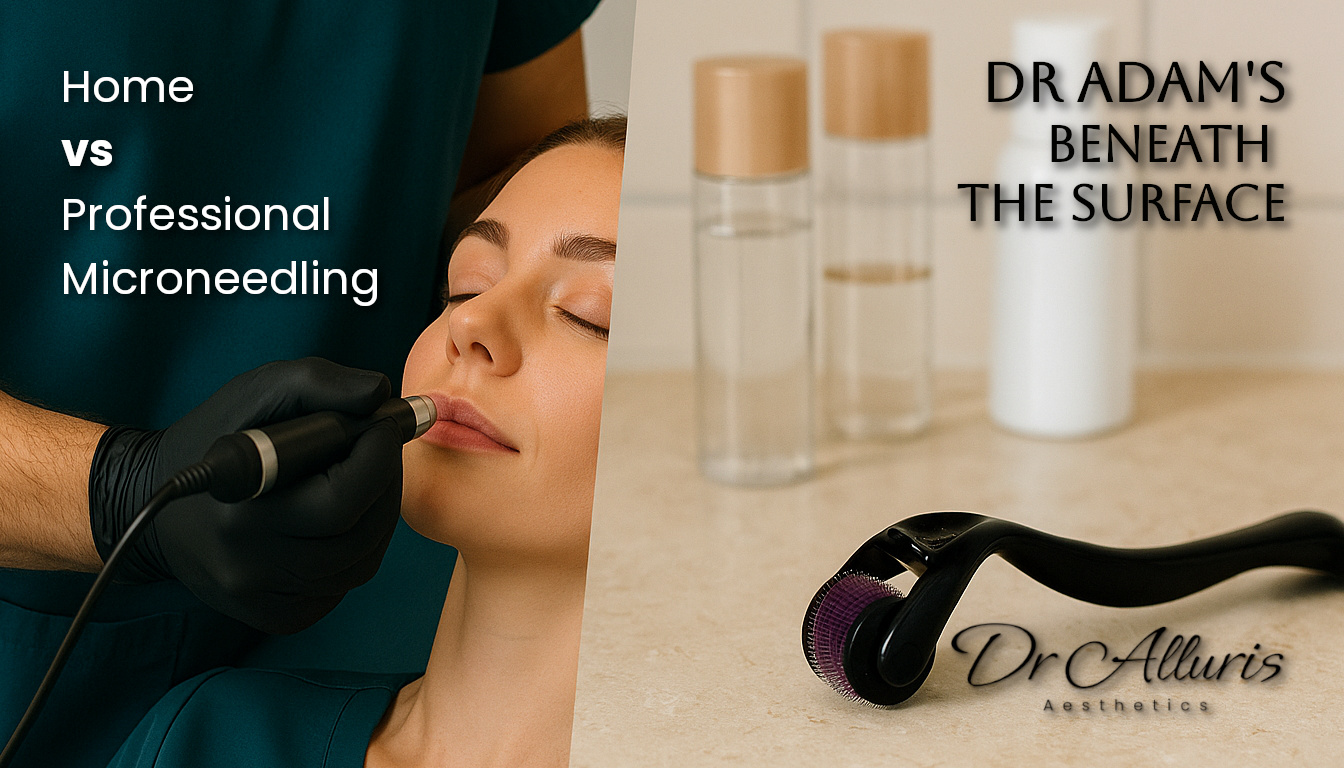
Needle depth is too shallow to stimulate collagen meaningfully. Most home dermarollers use needle lengths between 0.25mm and 0.5mm. At this depth you may see modest improvement in how your skincare products absorb, but you are unlikely to trigger any meaningful collagen production. Clinically, the depths that produce real structural improvement in the skin range from 1.0mm to 2.5mm, adjusted according to the area being treated and the individual skin condition. These depths should only be reached by a qualified practitioner using a calibrated medical-grade device.
Infection risk is genuine. Even shallow microneedling creates open channels in the skin surface. In a clinical setting, strict sterilisation protocols apply. Devices are single-use or properly sterilised between treatments, the skin is prepped correctly, and the environment is controlled. Home devices are typically reused, stored in bathrooms, and handled without the preparation that would be standard in a clinical context. The risk of introducing bacteria through those open channels is real, and the consequences, including infection, inflammation, and post-treatment pigmentation, can take months to resolve.
No assessment means no tailoring. Before any microneedling session at Dr Alluris Aesthetics, I assess the skin properly. Needle depth, treatment intensity, the areas to focus on, and whether to combine the session with a regenerative agent such as exosomes are all decisions made based on what I see at that assessment. At home, none of this is possible. A device applied without clinical knowledge of what the skin needs and how it is likely to respond is a generic approach, and generic approaches in skin treatment frequently produce inconsistent results or avoidable side effects.
Overuse is a common problem. Without guidance on appropriate intervals and recovery time, many people use home rollers too frequently. Skin that is not given adequate time to heal between sessions does not benefit from repeated stimulation. It becomes sensitised, reactive, and in some cases more damaged than before.
What Professional Microneedling Offers That Home Devices Cannot
- Calibrated depth and intensity adjusted in real time based on skin thickness, location, and individual response
- Sterile, medical-grade conditions at every step, significantly reducing infection and adverse reaction risk
- A thorough skin assessment beforehand to determine the right approach for your specific concerns and skin type
- Combination with regenerative agents such as exosome therapy, which can be applied during treatment to penetrate deeply through the micro-channels created and meaningfully enhance the biological result
- Clear, evidence-based aftercare instructions and direct access to me if anything feels unusual during healing
What You Can Safely Do at Home
There is a meaningful role for good at-home skincare between clinical treatments, and I am happy to guide you on this at consultation. The most effective home maintenance approaches include a well-chosen skincare routine with ingredients such as retinol, vitamin C, peptides, and barrier-supporting moisturisers containing ceramides or niacinamide. Non-invasive tools such as LED therapy masks or facial massage devices can also complement clinical treatments without the risks associated with needling the skin at home.
Think of your at-home routine as maintaining and extending the results of clinical treatments rather than replacing them. The two work best together.
My View on Home Microneedling
My honest view is that home microneedling at depths capable of producing meaningful results is not something I would recommend. The infection risk, combined with the absence of clinical assessment and the difficulty of controlling depth and technique, creates a risk-to-benefit profile that does not stack up well, particularly when professional treatment is accessible and the outcome is meaningfully better.
At very shallow depths, a home roller is low risk but also low reward. For anything beyond gentle product absorption enhancement, a clinical environment is the right setting. Your skin is not an area where guesswork and marketing claims are a sound basis for decisions.
A Simple Next Step
If you are considering microneedling and want to understand what would actually be appropriate for your skin, a consultation is the most useful place to start. I will assess your skin, explain what is realistic, and outline a plan that makes clinical sense for your specific concerns.
WhatsApp Dr Adam directly on 07721 390017, or book online at drallurisaesthetics.co.uk or via the online booking page.
Consultations are available at SkinTouch, 77 Church Road, Crystal Palace SE19 2TA and at 58 South Molton Street, Mayfair W1K 5SL.
Results vary between individuals. No treatment outcomes can be guaranteed. All treatments are subject to a clinical consultation to assess suitability.